Explore our services
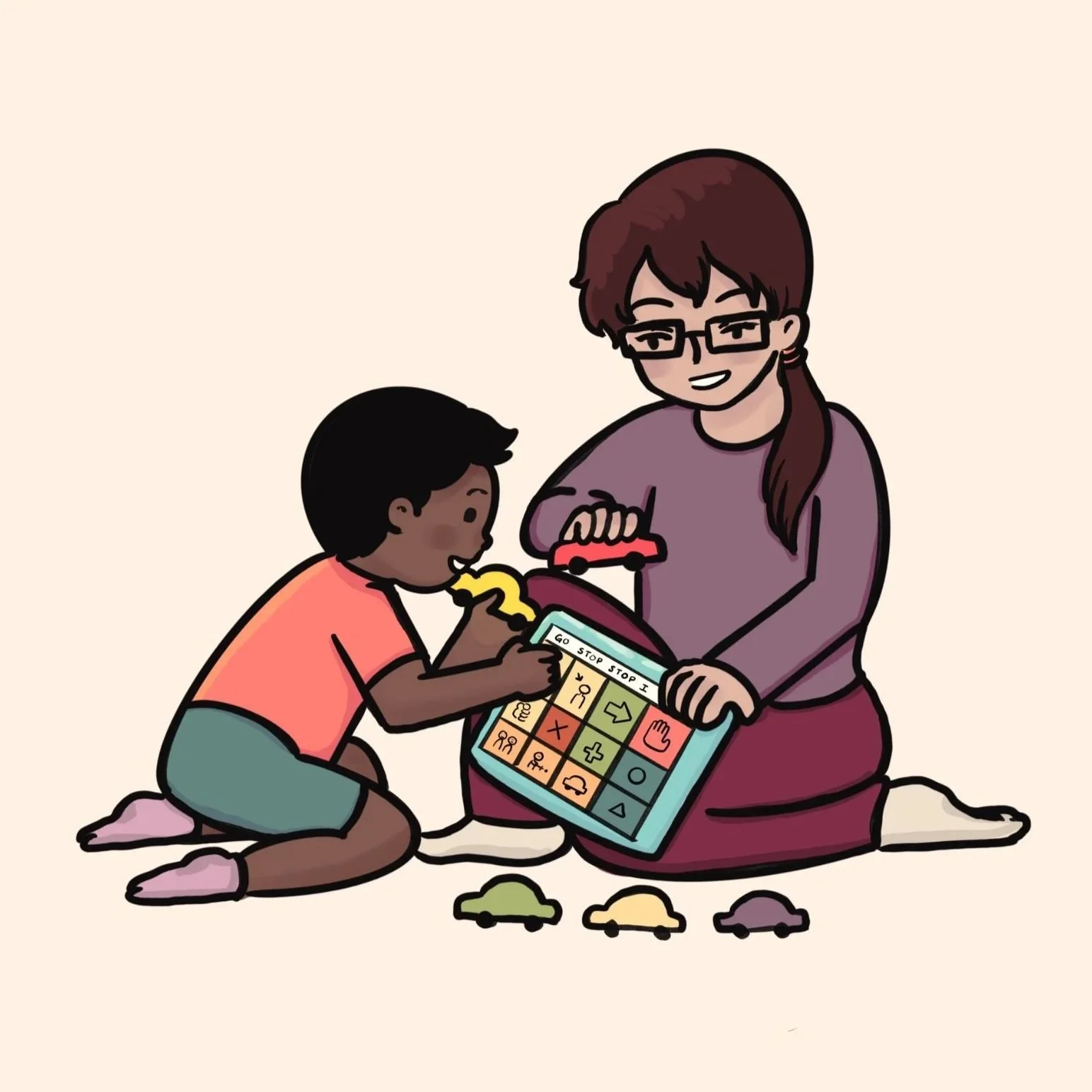
We provide individualized speech and language therapy to support communication development in children of all abilities. Our services target a range of needs, including articulation, expressive and receptive language, social communication, and more—helping every child build confidence and connect with the world around them.
We offer specialized therapy for gestalt language processors, focusing on supporting natural language development through meaningful scripts, echolalia, and language modeling. Our approach honors each child’s unique communication style while guiding them toward self-generated, flexible language in a respectful and neurodiversity-affirming way.

We provide comprehensive AAC evaluations to determine the most effective communication tools and strategies for each individual. Our team assesses language abilities, motor access, and communication needs to recommend personalized AAC solutions—from low-tech to high-tech systems. Evaluations are family-centered and include hands-on trials, training, and a collaborative plan for success.
We offer comprehensive evaluations to assess speech, language, and communication skills. Our assessments identify strengths and areas of need in understanding, expression, articulation, social communication, and more. Each evaluation includes a detailed report and personalized recommendations to support meaningful progress.

We offer supportive, judgment-free groups for parents and caregivers of AAC users. These sessions provide a space to share experiences, ask questions, and learn practical strategies for supporting communication at home and in the community. Led by experienced speech-language pathologists, our groups focus on connection, empowerment, and navigating the AAC journey together.
Our practice offers comprehensive speech-language IEEs for school districts, grounded in a neurodiversity-affirming framework. Evaluations are thorough, strengths-based, and culturally responsive, with a focus on functional communication across academic and real-world settings. We prioritize collaboration, clear reporting, and actionable recommendations that support student access, participation, and meaningful progress—while honoring each student’s unique communication profile.
Community-based therapy
Community-based therapy is a dynamic approach that helps clients transition the skills learned in traditional therapy settings to real-world environments. This type of therapy is designed to build confidence, independence, and functional communication in everyday situations. Here’s an in-depth look at how AAC therapy is effectively integrated into community settings:
Real-World Skill Application
1. Ordering at Restaurants:
Therapy sessions can incorporate role-playing exercises that simulate the process of ordering food. This may include:
Pre-Planning: Practicing restaurant menus and common phrases in a therapy room to build familiarity.
Simulation: Using a communication device to order food in a controlled environment with peers or therapists.
Community Integration: Visiting local restaurants where clients can practice ordering in real-life settings, reducing anxiety and building skills.
Therapists work with clients to tailor vocabulary for food items, polite requests, and expressions of preference. Over time, the goal is for clients to comfortably navigate a busy environment using their AAC tools.
2. Communicating at the Park:
Parks and other community spaces offer unique opportunities to practice spontaneous communication. In these settings, therapy may focus on:
Social Interactions: Engaging with peers and community members, practicing greetings, and sharing observations.
Navigation: Using AAC devices to ask for help or information, such as directions or the location of amenities.
Recreational Participation: Expressing needs and emotions while interacting during group activities like sports, games, or storytelling sessions.
This approach allows clients to gain exposure to varying levels of background noise and distractions, which are common in outdoor environments. Therapists use these experiences to help clients generalize their communication skills beyond structured practice sessions.
Contact us
At this time, we are only accepting requests for evaluations & IEE’s. The caseload for therapy is currently full.